Why Awareness Through Movement® lessons are not demonstrated
I want to share a bit about the Feldenkrais Method® and in particular the Awareness Through Movement® lessons.
These are somatic movement lessons designed to enhance your awareness of yourself to be able to start noticing what's already there in the way you move, breathe and organize yourself.
The lessons aren’t about copying movements. They are not so much even about the movements. They are about the process of how you attend to yourself within the movements and what you begin to notice when you do. They are about sensing.
Self-image is your sense of yourself, your internal picture of yourself. It is what you hold to be true about your strengths, your weaknesses, your capabilities and what you believe you can and cannot do. You act in the world according to that picture. What you think to be true guides your behavior. And you can often see and sense it in posture. Your thinking has a physical organization. When you believe you are not flexible, you don’t engage in movements that you believe require flexibility. What you’ll do instead is stop yourself in your tracks before even giving it a try.
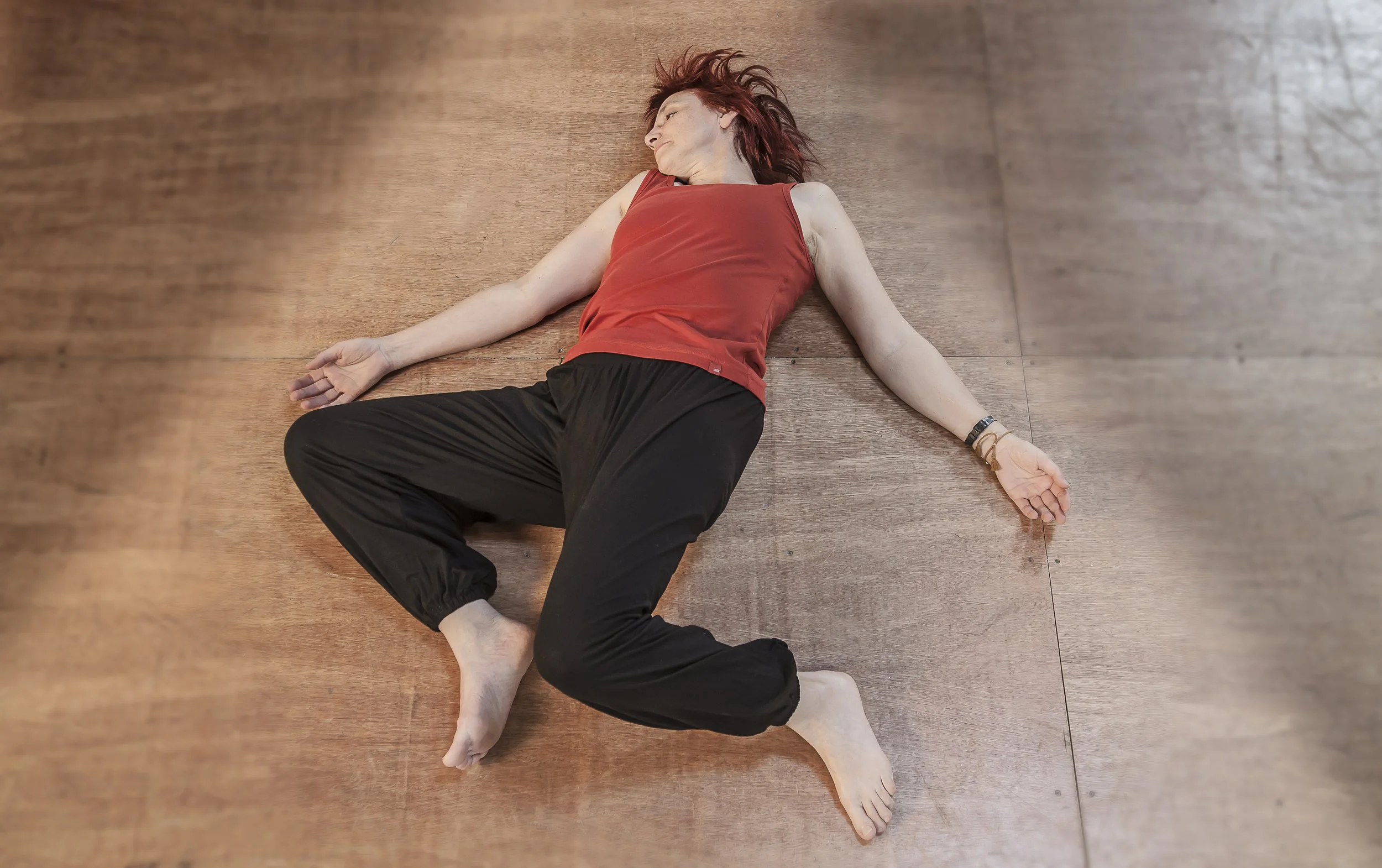
Photo credit:© International Feldenkrais® Federation & Robert Golden. All rights reserved.
“This looks slow and boring.”
When observing, it’s easy to think this is too slow, too boring and there is nothing to gain from this kind of movement lesson. After all, it’s not stretching nor strength training nor will it get your heart rate elevated.
But there is an intricate process taking place between what you can see and what you can sense.
Listening to what moves and how it moves
Noticing where you hold your breath and what allows it to move freely
Noticing where movement gets stuck and where it feels effortless
Discovering which places and what ways of moving are completely out of your awareness at this time and how the movement changes once your attention lands on them
Detecting the first moment of discomfort so you can choose a different path
Trying out initiating movement from different places and sensing the difference it makes in the quality of movement
This kind of attentiveness is what your brain hungers for. You are practicing detecting differences and experiencing something new each time which is how you learn. It is also one of the ways you can support your brain’s adaptability as you age.
Why copying from the outside can take you away from yourself
Take running as a simple example.
You might look at a friend or another runner who seems really good at what they are doing. You try to mimic their gait, how they hold their arms and the length of their stride.
Yet you have your unique skeletal organization and your unique muscular patterns built around supporting your skeletal organization. You have your way of breathing and using your eyes. You might have an underlying injury that makes it painful to use your arm in a specific way.
Now if you are simply going to mimic what the other person does because you think that’s what an effective runner looks like you very well may actually injure yourself or have a far heavier stride compared to your model. Yet you keep pushing because you think that’s what it should be and you just need to try harder and be more persistent.
You will not be able to improve until you start listening to your organization and until it feels more effortless to you.
This is why Awareness Through Movement® lessons are not so much about the movements themselves but the process of how you attend to yourself within the movements. It’s about sensing your patterns.
What you begin to notice instead
You might ask:
Which areas have you completely omitted from your experience of yourself?
Example: As you roll your head side-to-side, do you think of just your head moving? Or can you roll your head in a way where you have your whole self in your mind and noticing how that changes the quality of the rolling.
How do these omissions affect how you experience yourself within the movement?
Example: If you notice that you have a tendency to hold your breath as you begin to roll your head to one side, what happens if you ever so slightly adjust the angle that you roll your head in, does that allow your breath to remain free?
What are your limiting thoughts about what you are capable of doing?
Example: How do you talk to yourself when you meet a limit or something is hard to do. “I should be able to roll further.” “This shouldn’t feel this difficult.” “I am too old to be doing this.” “Why can’t I figure out what else to try.”
Vs “What if I move this way.” “I wonder how do I do this on the other side.” “What could I teach my other side.”
What do you think you should feel for it to count and where did you learn that?
Do you think you should feel a stretch? Do you think you should feel effort? Do you think you should feel something dramatic for it to be working? Where else do you ask do you use the very same thinking (and judging) pattern with yourself?
How do your physical patterns and how you interpret instructions shape the tone you feel inside yourself while you move?
No one can “show you” your patterns
No one can show you your patterns. And even if they would, you might not even believe them. They really need to be felt by you.
It’s about making distinctions and pulling things apart and looking at yourself through a lens of curiosity.
Try for yourself
One thing is to absorb information and feel, “yes, that makes sense.”
It’s another thing to take what you absorbed into action. That’s where you learn. You learn your own truth about it. That doesn’t make someone else’s truth right or wrong, but you learn about you.
So if you feel curious, try it out for yourself. Find a teacher you feel you can resonate with or try a lesson recording and give yourself the time to listen and honor yourself as you go.
When you do engage in a lesson, notice what comes up for you. Are you bored, curious, what “truths” are you telling yourself. And just stay with that. Notice it and try a different way of engaging with that feeling or thought. And do that without any judgement but rather curiosity to know more of the person that you are.
- Thank you for reading